Forex Management Insights
Treasury Transformation Starts with Better Decisions, Not Better Technology
Successful treasury transformation is not defined by the technology implemented, but by the quality of the decisions it enables. Building capability before systems creates stronger governance, more consistent decision-making and better long-term outcomes.
-
Nicky Breach
- Reviewed by the Valufin Forex Treasury Team
- 4 minutes read

Treasury transformation is not a technology project
When organisations begin a treasury transformation programme, the conversation often starts with technology. Which Treasury Management System should we implement? How can we automate payments? Do we need better cash visibility or a new banking platform?
These are important questions, but they are rarely the first questions that should be asked. Technology rarely transforms treasury on its own. Instead, it amplifies the way treasury already operates. If decision-making is inconsistent, governance is weak or processes are fragmented, implementing new technology simply allows those weaknesses to operate more efficiently.
The result is often greater operational complexity, inconsistent risk decisions and significant investment without a corresponding improvement in treasury performance.
One of the most common assumptions is that better visibility naturally leads to better decisions. It is an understandable starting point. Better data, greater automation and more sophisticated reporting appear to reduce uncertainty. The challenge is that information, on its own, rarely improves decision quality.
Treasury must first define the decisions it is trying to improve before determining what information it actually needs. Without that clarity, greater visibility simply creates more data to interpret rather than better decision-making.
Successful treasury transformation begins much earlier. It starts with understanding how treasury decisions are made, who makes them, what information they rely on and how consistently those decisions are applied across the organisation.
The objective is not to implement better software. It is to build a treasury function capable of making better decisions across liquidity, cash forecasting and financial risk management.
“Technology amplifies the way treasury already operates. It does not transform it.”
Technology enables capability. It does not create it.
Many transformation programmes assume that new software will solve existing operational problems. In reality, technology sits towards the end of the transformation journey rather than the beginning.
A Treasury Management System cannot define an organisation’s risk appetite, improve forecasting discipline or establish clear governance. It cannot determine how treasury supports strategic decision-making or how financial risk should be managed. These are management decisions that require clarity long before software configuration begins.
This distinction is particularly important where treasury decisions influence market risk, such as managing foreign exchange exposure. Technology can support execution, improve visibility and automate processes, but it cannot determine the right hedging strategy, risk appetite or decision framework. Those choices remain management responsibilities, regardless of how sophisticated the technology becomes.
Technology provides the infrastructure to execute those decisions consistently. Without that foundation, even the most sophisticated platform risks automating inefficient processes rather than improving them.
Treasury transformation is an operating model redesign
Before selecting technology, organisations need a clear understanding of how treasury creates value today. That requires more than reviewing policies or process documentation. It means understanding how treasury actually operates in practice.
How are FX decisions made? Who owns cash flow forecasts? Where does liquidity information originate? Which activities depend on spreadsheets, manual intervention or informal workarounds? How are exceptions escalated, and where do delays occur?
These questions define the Current Operating Model (COM). Without an accurate view of today’s reality, any future design is built on assumptions rather than evidence.
Only once the current operating model has been validated can a Target Operating Model (TOM) be designed with confidence. Technology should then be selected to support that operating model, not to define it. When technology is selected first, organisations often find themselves redesigning processes around system capabilities rather than around the decisions treasury actually needs to make.
“Treasury must first define the decisions it is trying to improve before determining what information it actually needs.”
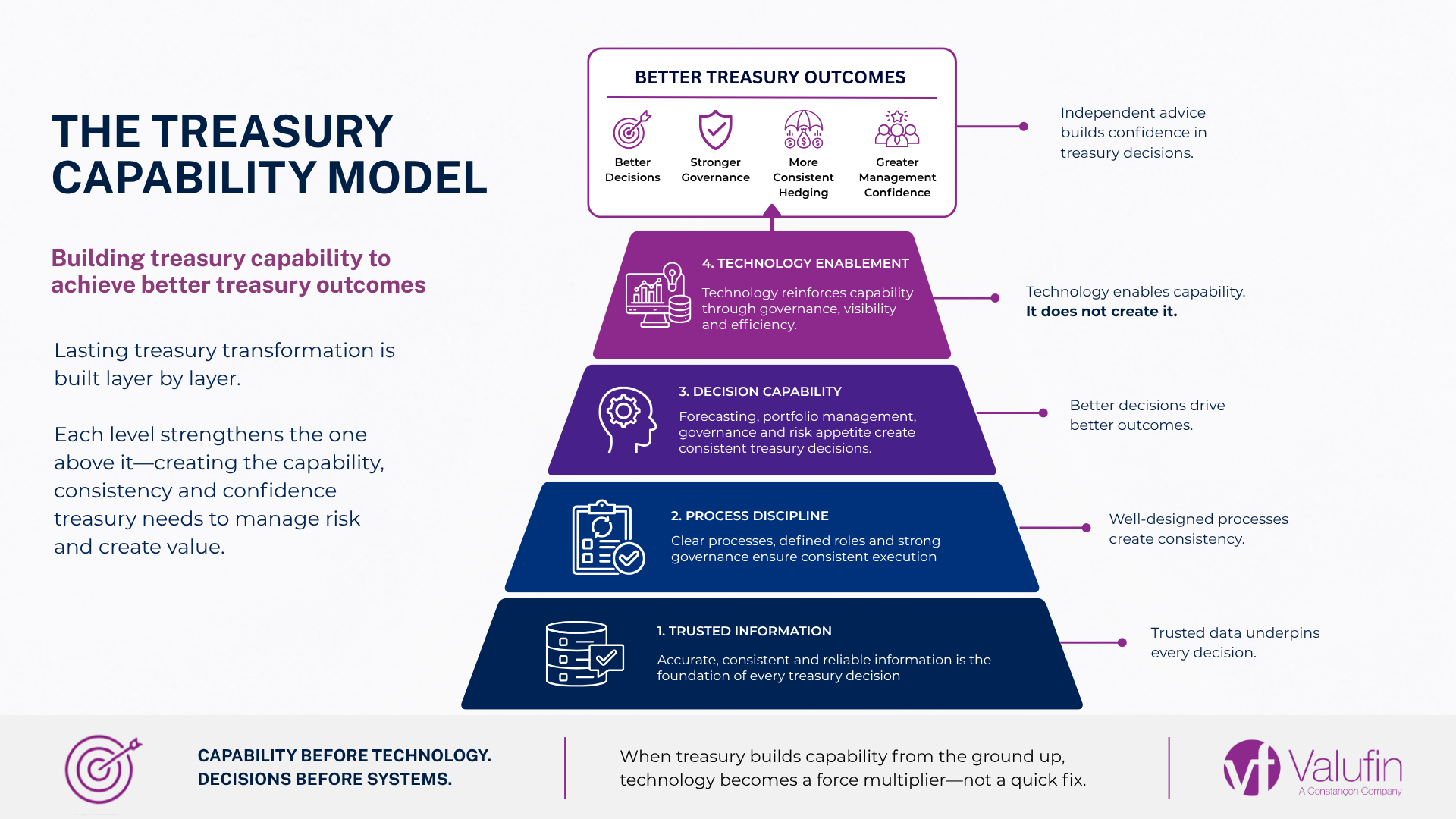
The Treasury Capability Model
One of the most common misconceptions is that treasury capability begins with technology. In reality, capability develops progressively, with each layer providing the foundation for the next.
At Valufin, we think about treasury transformation through the Treasury Capability Model. It illustrates how organisations build the capabilities required to achieve better treasury outcomes. Technology plays an important role, but only after trusted information, disciplined processes and strong decision capability have been established.
Level 1 — Trusted Information
Every treasury decision depends on reliable information. Forecasts, cash positions, banking data and market information must be accurate, consistent and trusted. This is particularly important where forecast exposures are used to support foreign exchange hedging decisions, as the quality of the decision can never exceed the quality of the underlying information. Without confidence in the underlying data, even experienced treasury teams struggle to make informed decisions.
Level 2 — Process Discipline
Reliable data alone is not enough. Treasury processes must be clearly defined, repeatable and supported by appropriate governance. Roles, responsibilities and approval structures remove ambiguity while ensuring decisions are executed consistently.
Level 3 — Decision Capability
Once information and processes are under control, treasury can focus on developing stronger decision capability. Forecasting, portfolio management, governance and risk appetite come together to support more consistent financial decisions. Whether managing liquidity or foreign exchange exposure, organisations that develop decision capability are better equipped to respond confidently under changing market conditions rather than reacting to short-term market movements.
The objective is not simply to perform treasury activities more efficiently, but to build the capability to make consistently better decisions.
Level 4 — Technology Enablement
Technology sits at the top of the model because it enables capability rather than creating it. A well-configured Treasury Management System reinforces governance, improves visibility and increases operational efficiency. However, it cannot compensate for weak information, poorly designed processes or limited decision capability.
Organisations that attempt to build the model from the top down often find themselves replacing systems without addressing the underlying causes of poor treasury performance.
Why treasury transformation programmes struggle
Transformation projects rarely fail because of software. More often, they struggle because the organisation attempts to implement technology before establishing the capabilities required to support it.
Common symptoms include unclear objectives, inconsistent forecasting, fragmented ownership, poor data quality and governance frameworks that exist on paper but not in practice. These issues often remain hidden during project planning, only becoming visible once implementation is underway.
The result is predictable. Teams spend months configuring systems while simultaneously redesigning processes, cleansing data and resolving governance issues that should have been addressed from the outset.
Successful transformation follows the opposite sequence. It establishes capability first and then uses technology to reinforce it.
“Treasury transformation should not be judged by the quality of the technology implemented, but by the quality of the decisions it enables.”
Measuring transformation by better decisions
Many organisations measure transformation success through project milestones. Systems are implemented, interfaces are completed, users are trained and go-live dates are achieved. While these are important delivery milestones, they do not necessarily demonstrate that treasury has become more effective.
A more meaningful measure is whether treasury decisions have improved.
Are forecasts becoming more reliable? Are hedging decisions becoming more consistent as a result? Is treasury identifying risks earlier? Are policy exceptions reducing? Does management have greater confidence in treasury recommendations? Are decisions becoming more consistent across the organisation?
These are the outcomes that determine whether transformation has genuinely strengthened treasury capability rather than simply modernised technology. Ultimately, stronger treasury decisions contribute to more resilient business performance by improving the quality and consistency of financial risk management.
Treasury transformation should not be judged by the quality of the technology implemented, but by the quality of the decisions it enables. Organisations that begin with systems often modernise infrastructure. Organisations that begin with capability transform the way treasury creates value.
Valufin helps organisations strengthen treasury decision-making by aligning governance, operating models and foreign exchange risk management. We believe lasting treasury capability is built through better decisions—not better technology alone.
Is Your Treasury Transformation Built on Capability or Technology?
Successful transformation begins long before system implementation. Discover how stronger governance, operating models and decision-making can create more effective treasury outcomes.