
Forex Management Insights
What Is Outsourced Forex Treasury Management?
For many businesses trading internationally, foreign exchange sits within the wider finance function rather than with a dedicated treasury team. The CFO or Finance Director may therefore manage exposures, hedging decisions, provider relationships and reporting alongside wider financial responsibilities.
Outsourced Forex Treasury Management adds specialist treasury capability within a defined mandate. Agreed treasury activities can be managed externally, while the business retains its commercial objectives, governance and ultimate accountability.
-
Nicky Breach
- Reviewed by the Valufin Forex Treasury Team
- 7 minutes read

Key takeaways
- Outsourced Forex Treasury Management extends the finance function with specialist treasury capability; it does not transfer the business’s ultimate accountability.
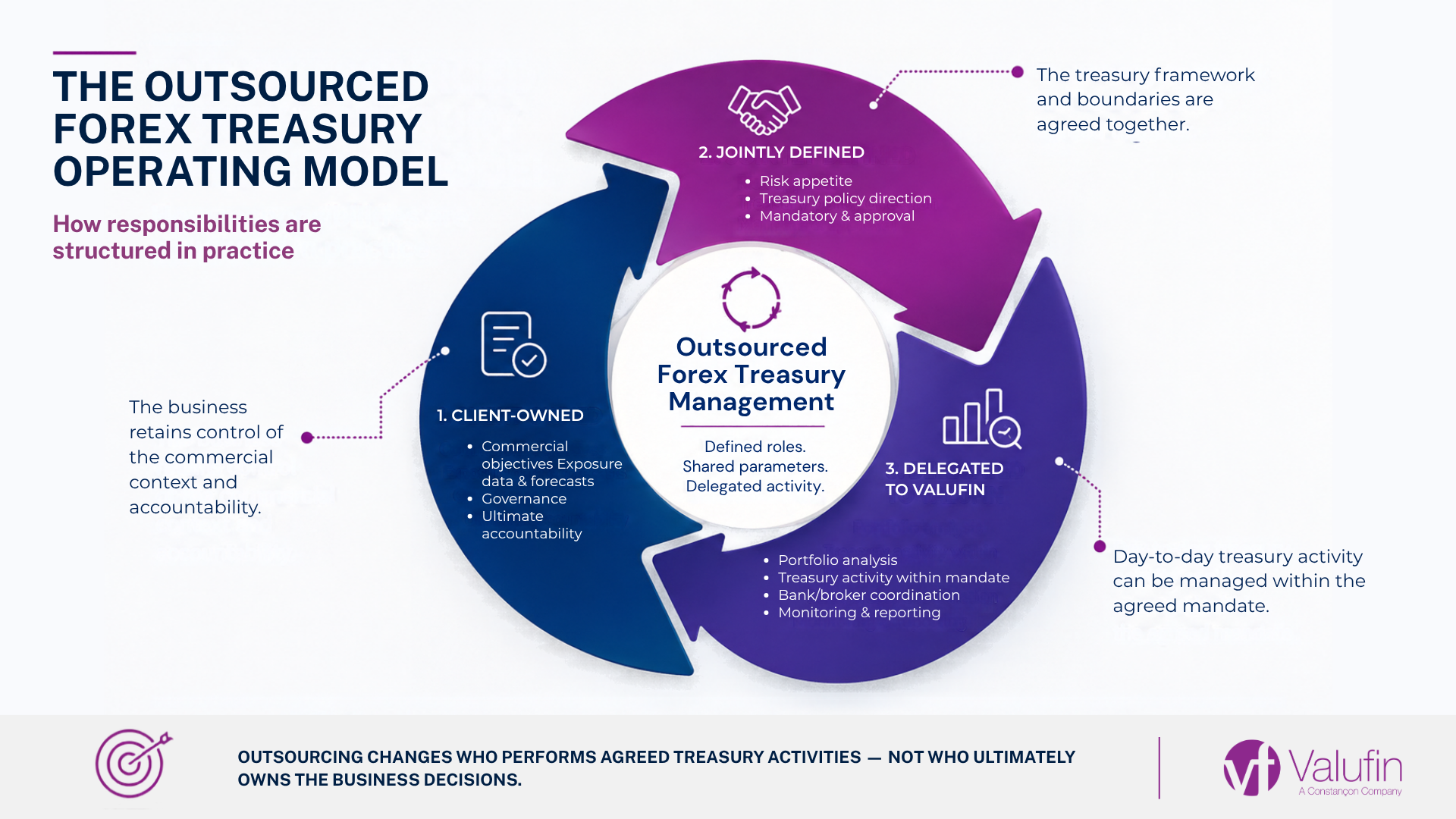
- The operating model has three layers: responsibilities that remain client-owned, treasury parameters defined jointly, and activities delegated within an agreed mandate.
- The business supplies the commercial and exposure information; the outsourced specialist uses it to analyse the portfolio and manage agreed treasury activity.
- The model can give finance teams access to specialist capability, continuity, visibility and process discipline without assuming that outsourcing is always the right delivery model.
What Is Outsourced Forex Treasury Management?
Outsourced Forex Treasury Management is an operating model in which a business delegates agreed treasury activities and specialist capability to an external provider that operates as an extension of its finance function or outsourced treasury department, while the business retains ownership of its commercial objectives, governance and ultimate accountability.
The model has three connected layers:
- responsibilities that remain client-owned,
- treasury parameters that are defined jointly with the specialist,
- and day-to-day treasury activities that are delegated within an agreed mandate.
This is broader than arranging individual FX transactions. Outsourced treasury management – sometimes described more generally as treasury outsourcing or outsourced FX management – connects the commercial exposures created by the business to portfolio analysis, treasury decisions, execution, monitoring and reporting as one continuing process.
Why Do Businesses Use an Outsourced Treasury Model?
The model is often considered when a business has genuine foreign-currency responsibilities but does not maintain enough specialist treasury capability internally to manage them as a dedicated function.
For a CFO or Finance Director, the practical value is access to specialist expertise and ongoing operational capacity around work that might otherwise sit alongside a much wider finance role. That can make the treasury process more structured, provide clearer management visibility and move part of the day-to-day FX workload into a dedicated specialist process.
The point is not that outsourcing is automatically better than building capability internally, but that it provides an alternative way to access specialist treasury expertise, continuity and operational support.
The relevant question is how that external capability can be integrated into the finance function when a business wants more specialist support or process discipline than it currently maintains in-house.
Outsourced Forex Treasury Management adds specialist treasury capability without transferring control of the business itself.
What Treasury Activities Can Be Delegated?
The exact scope varies by business and mandate, but an outsourced treasury function can cover a broad part of the foreign-treasury process. The client supplies the source exposure information; the specialist manages the agreed treasury work around it.
Delegated activity can include:
- Portfolio analysis and oversight – analysing exposures, forecasts, cash-flow requirements and the overall currency position;
- Treasury strategy and hedging decisions – translating the business context into a risk-management approach, assessing hedging needs and recommending timing, structure, volumes and appropriate instruments;
- Transaction-provider coordination – working with banks, brokers and other FX providers, assessing pricing and negotiating transactions on the client’s behalf within the agreed mandate;
- Operational management – monitoring transactions and maturities and providing agreed foreign-treasury administration, confirmations and related accounting or reconciliation support; and
- Reporting and review – providing management information, reviewing the portfolio and policy, and challenging the approach when the underlying business position changes.
These functions work together. Portfolio analysis informs the strategy; the strategy guides transaction decisions; those transactions alter the portfolio; and monitoring and reporting feed the resulting position back into the next decision.
For example, a UK importer buying regularly in US dollars may provide expected orders, invoice dates and payment timings while the outsourced treasury specialist manages the resulting USD exposure as part of the wider portfolio rather than treating each payment as an isolated FX trade.
What Remains Client-Owned, and What Is Jointly Defined?
Outsourcing day-to-day treasury activity does not remove the responsibilities that depend on the business’s own commercial knowledge, governance and management authority.
Client-owned responsibilities
- the underlying commercial objectives and strategic priorities of the business;
- accurate and timely exposure, forecast, order, invoice, cash-flow and accounting information;
- internal commercial judgement about pricing, purchasing, sales, investment and operating plans;
- governance and escalation structures, including the authority to agree or change the boundaries of delegation; and
- ultimate management accountability for the treasury framework and decisions made within it.
Those responsibilities originate inside the organisation. An external specialist can analyse and act on the information supplied, but it cannot create reliable source data or make the business’s wider commercial decisions for it.
Treasury parameters defined jointly
Some important treasury parameters sit between what the business retains and what it delegates.
They are shaped collaboratively, using the client’s business priorities together with the specialist’s forex expertise.
- how commercial objectives translate into forex treasury decisions;
- risk appetite in practical treasury terms and the policy direction that follows from it;
- the operating methodology, degree of client engagement and approval boundaries; and
- strategic cover decisions or changes to hedge ratios where client involvement is required.
A manufacturer buying components in euros while selling mainly in sterling, for example, still owns the purchasing, sales and pricing decisions that create the exposure. The treasury specialist can then use that business context to help define and manage the resulting EUR position within the agreed framework.
Outsourcing can transfer day-to-day treasury responsibility, but the business retains its commercial objectives, governance and ultimate accountability.
How Does Outsourced Forex Treasury Management Work in Practice?
The operating relationship is a continuing loop of business information, treasury analysis, tactical action and review. The client supplies the underlying exposure and commercial information; the specialist analyses the portfolio, applies the agreed strategy and manages the activity permitted by the mandate.
As new orders, invoices, forecast changes, payment movements or other business changes alter the exposure, the portfolio is reassessed. Existing hedges, future requirements and planned actions can then be considered against the updated commercial position rather than handled as isolated transactions.
Information therefore needs to move in both directions. The business provides the commercial inputs; the specialist turns them into treasury analysis, recommendations, portfolio visibility and management information. The frequency and method of that exchange can be adapted to the business and its operating cycle.
How Do the Mandate, Approvals and Delegated Authority Work?
The operating mandate defines the boundaries of the relationship. It records the agreed strategy, the activities the specialist is responsible for, the degree of client involvement and the authority delegated for day-to-day activity.
Under Valufin’s current operating model, day-to-day tactical activity is commonly managed within an agreed strategy without separate approval for every action. The client is usually more directly involved when additional cover is taken, hedge ratios change or a decision falls outside the agreed mandate.
Some clients choose to remain more closely involved, so a recommendation may be discussed and agreed before action is taken. In other relationships there are fewer individual approval points because the strategy and authority have already been defined.
The important point is that delegated authority is not unrestricted control. The mandate gives the specialist enough room to manage the activities it has been engaged to perform while leaving the client in control of the boundaries and the decisions that sit outside them.
Delegated authority is not unrestricted control. The mandate defines where the specialist can act and where the business remains directly involved.
Where Do Banks, Brokers and Other FX Providers Fit?
Banks, brokers and other FX providers remain part of the operating model because the FX transaction itself is contracted between the client and the bank or broker. They provide the market relationship, pricing, instruments, facilities and transaction capability required to carry out FX activity.
Valufin sits operationally between the client and those providers. A Valufin person normally negotiates the transaction with the bank or broker on the client’s behalf and in the client’s name, while the contractual transaction remains between the client and the provider.
This also means outsourced treasury can work alongside existing bank and broker relationships. The specialist manages the wider treasury process around those transaction providers rather than requiring the business to treat treasury management and market access as the same role.
Banks and brokers provide the transaction relationship. Outsourced treasury management connects those transactions to the business’s wider exposure, strategy and governance.
What Role Do Monitoring, Reporting and Review Play?
Delegating treasury activity should not create a black box. Management still needs visibility of the exposures being managed, the transactions in place, the portfolio position and any exceptions requiring attention.
Depending on the client and mandate, reporting can cover exposures, hedge or transaction positions, portfolio information, cash-flow impact, mark-to-market information, management dashboards and Board reporting. Review can also include transaction and maturity monitoring, policy review, regular discussions and alerts when an exception or risk needs management attention.
The practical benefit is management visibility. The finance team may not be making every tactical treasury decision, but it should still be able to understand what has been done, how the position has changed and whether the strategy or mandate needs to be revisited.
When Might an Outsourced Forex Treasury Model Be Relevant?
An outsourced model may be relevant when a business wants specialist forex treasury capability that it does not maintain sufficiently in-house. The deciding factor is not simply the size, frequency or complexity of the currency exposure.
The model can therefore be relevant to different types and sizes of business. A Finance Director in an importer, an internationally trading manufacturer or a service business billing customers in multiple currencies may face genuine treasury responsibilities even when the organisation does not maintain a dedicated internal forex treasury function.
Valufin still works with an internal contact, so outsourcing does not remove the organisation from the process. Where a business already has the specialist expertise, systems and capacity it needs internally, the delivery-model question is different and belongs to the wider comparison of in-house and outsourced approaches.
The practical question is not simply whether treasury is “in-house” or “outsourced”. It is which responsibilities remain with the business, which treasury parameters are defined jointly, what can be delegated to the specialist, and how the arrangement works alongside existing banks, brokers and internal decision-makers.
What Should Be Clear Before Evaluating an Outsourced Treasury Arrangement?
Before evaluating an outsourced arrangement, the business should understand the operating model it expects to create. That means being clear about the responsibilities, information flows, authority and governance that will connect the internal team, the outsourced specialist and existing transaction providers.
The business should be able to define or discuss:
- Which treasury activities it wants managed externally and which responsibilities will remain client-owned;
- What business and exposure information will be supplied, how it will be maintained and who owns its accuracy;
- How commercial objectives and risk appetite should translate into treasury strategy and policy;
- What level of delegated authority is appropriate, what still requires client involvement and how exceptions will be escalated;
- How the outsourced specialist will work with existing banks, brokers and internal stakeholders; and
- What monitoring, reporting and review is needed to preserve management visibility and oversight.
These are questions about the shape of the operating relationship, not about proving that outsourcing is better or cheaper.
External expertise can add capability, continuity and process discipline, but it cannot replace reliable internal information, remove the need for governance or take away ultimate management accountability.
Outsourcing Treasury Capability Without Outsourcing Accountability
Outsourced Forex Treasury Management is ultimately about adding specialist treasury capability without giving up control of the business itself. The company retains its commercial objectives, source information, governance and ultimate accountability, while agreed treasury activities can be managed externally within a clearly defined mandate.
For finance teams, that can mean moving from a collection of individual FX tasks towards a more structured treasury process — one that connects exposures, decision-making, execution, monitoring and reporting while keeping management visibility and responsibility firmly inside the business.
If your business is considering how an outsourced treasury arrangement could work in practice, Valufin can discuss how the responsibilities, mandate, information flow and level of delegated support could fit around your existing finance structure.
Frequently Asked Questions
Is outsourced Forex Treasury Management the same as using an FX broker?
No. A broker or bank provides the transaction relationship, pricing and execution capability. Outsourced Forex Treasury Management covers the wider process of understanding the business exposure, managing the portfolio, applying an agreed strategy, coordinating transactions, monitoring the position and reporting back to management.
Can outsourced treasury work with our existing banks and FX brokers?
Yes. Existing banks and brokers can remain the market counterparties. The outsourced treasury specialist can work around those relationships, coordinating and negotiating transactions within the agreed mandate while managing the wider treasury process.
Does outsourcing mean the external provider makes every treasury decision?
No. The level of authority is defined through the mandate. Day-to-day activity can be delegated within agreed parameters, while the client remains involved where strategic changes or out-of-mandate decisions arise.
Can a business outsource some treasury activities and keep others in-house?
Yes. Scope is built around the business and the mandate rather than a fixed service tier. Some activities can remain internal while others are delegated, provided responsibilities, information flow and decision rights are clear.
Does the CFO still retain responsibility when treasury is outsourced?
Yes. Outsourcing can transfer substantial operational responsibility, but the business still owns its commercial objectives, source information, governance and ultimate management accountability.
Is outsourced Forex Treasury Management only relevant to large or complex businesses?
No. Relevance is not determined solely by business size or by whether the exposure is large, recurring or complex. The stronger question is whether the business wants specialist forex treasury capability that it does not maintain sufficiently in-house.
Valufin provides outsourced Forex Treasury Management to help businesses add specialist treasury capability, manage agreed activities within a defined mandate, and retain control of their commercial objectives, governance and accountability.
Review how your current Forex Treasury responsibilities, decision rights and day-to-day activity are structured.
Speak to Valufin about how an outsourced Forex Treasury Management arrangement could fit around your existing finance function.