Valufin Framework Insights
From Transactions to Portfolio Management: A Better Way to Manage FX Risk
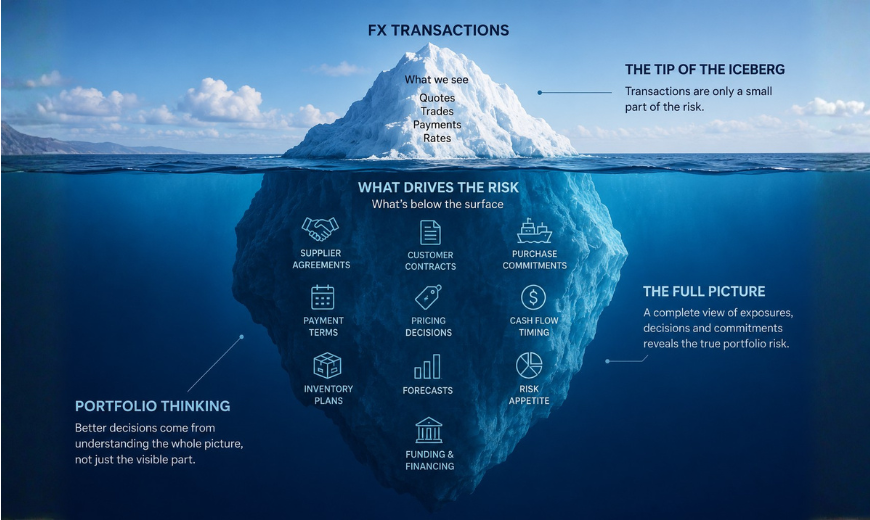
Foreign exchange risk is rarely created by a single transaction. It emerges from the combined impact of supplier agreements, customer contracts, payment terms, pricing decisions, and treasury actions across the business. The challenge is not simply executing foreign exchange transactions efficiently, but managing the portfolio those transactions collectively create.
-
Nicky Breach
- Reviewed by the Valufin Forex Treasury Team
- 7 minutes read
For many organisations, foreign exchange management is something that happens at the point a transaction requires attention. A supplier invoice arrives in a foreign currency, a customer payment is expected from overseas, or a significant purchase order is placed with an international vendor. At that moment, attention turns to the exchange rate, a provider is contacted, and a decision is made.
On the surface, this appears entirely reasonable. Foreign exchange activity ultimately manifests itself through transactions, and it is natural for finance teams to focus on the events that require action. However, this approach can create a subtle but significant problem. When foreign exchange management becomes centred on individual transactions, organisations often lose sight of the broader portfolio of exposures, risks, and opportunities that those transactions collectively create.
This distinction between managing transactions and managing a portfolio lies at the heart of effective FX risk management.
Over many years of working with businesses involved in international trade, a recurring pattern emerges. Organisations frequently devote considerable effort to securing competitive exchange rates, selecting providers, and deciding whether or not to hedge. Yet far less attention is often given to how these individual decisions interact with one another across the wider business. As a result, foreign exchange management can become fragmented, reactive, and heavily influenced by operational events rather than strategic objectives.
The reality is that foreign exchange risk is not created by individual transactions. It is created by the collective impact of a company’s trading activities, commercial decisions, supply chain arrangements, funding structures, and risk management practices. Managing that risk effectively requires a portfolio mindset.
The Portfolio Exists Long Before a Trade Is Executed
One of the most common misconceptions in foreign exchange management is that exposure begins when a transaction enters the market. In reality, exposure often begins much earlier.
A business importing products from overseas creates exposure when it agrees commercial terms with a supplier. An exporter accepting orders in a foreign currency creates exposure when pricing decisions are made. Inventory planning, production schedules, shipping lead times, customer credit arrangements, and contractual obligations all contribute to the profile of risk that eventually appears within the treasury function.
Viewed in this way, foreign exchange exposure is not simply a financial phenomenon. It is a commercial consequence of how the business operates.
This is one reason why every organisation’s foreign exchange portfolio is unique. Two companies operating within the same sector may have entirely different risk profiles because their supply chains, customer bases, pricing strategies, and operating models differ. One organisation may purchase inventory six months in advance, while another operates on a just-in-time basis. One may trade primarily in US dollars, while another manages exposure across multiple currencies. One may benefit from natural offsets between imports and exports, while another carries directional risk throughout the year.
These differences matter because they shape the portfolio that treasury teams are required to manage. The foreign exchange portfolio is therefore not simply a collection of contracts or transactions. It is a financial reflection of the business itself.
Understanding that relationship is fundamental to moving beyond transactional decision-making.
“Foreign exchange risk is not created by individual transactions. It is created by the portfolio of exposures, decisions, and commercial commitments that those transactions collectively represent.”
The Limitations of Transaction-Based Thinking
When foreign exchange decisions are made solely in response to operational events, treasury management can become reactive by nature.
A payment becomes due and currency is purchased. An invoice arrives and cover is arranged. Market rates move favourably and management decides to accelerate a transaction. Rates move unfavourably and decisions are delayed in the hope that conditions improve.
While each decision may appear rational when viewed in isolation, collectively they can create an inconsistent approach to risk management.
One of the challenges with transaction-based thinking is that it encourages organisations to focus on the outcome of individual decisions rather than the effectiveness of the portfolio as a whole. Treasury teams can become preoccupied with whether a particular trade was executed at the optimal rate, while paying less attention to whether the overall structure of exposures remains aligned with the company’s objectives.
This tendency is reinforced by hindsight. Every transaction can be judged after the event. It is easy to identify what would have been the perfect decision once market movements have already occurred. Yet successful treasury management has never been about achieving perfection on individual trades. Markets are too complex, and future outcomes too uncertain, for that objective to be realistic.
A more productive question is whether the portfolio is positioned appropriately given the information available at the time decisions are made.
This shift in perspective changes the nature of foreign exchange management. The focus moves away from attempting to predict short-term market movements and towards creating a structure that can support the business through changing market conditions.
Understanding Risk Through Portfolio Positioning
Perhaps nowhere is the difference between transactional and portfolio thinking more evident than in discussions around cover ratios.
Many organisations seek certainty through simple rules. They may establish policies requiring a fixed percentage of exposure to be hedged, or they may adopt broad principles designed to remove decision-making complexity. While such approaches can create consistency, they do not necessarily create effective risk management.
The challenge is that foreign exchange risk is not static.
The level of risk associated with a particular exposure depends on numerous factors, including the time horizon involved, the predictability of future cash flows, the competitiveness of the market, the flexibility of pricing arrangements, and the organisation’s overall risk appetite.
As a result, there is rarely a universally correct level of cover.
An organisation with highly predictable order volumes and long production cycles may reasonably choose a different approach from a business operating in a rapidly changing market where demand fluctuates significantly. Likewise, a company with strong margins and pricing flexibility may tolerate a different level of exposure than a business operating on narrow margins where exchange rate movements can have an immediate impact on profitability.
The purpose of cover is therefore not to eliminate risk entirely. Rather, it is to position risk appropriately within the context of the wider portfolio.
This is an important distinction because both extremes can create problems. An organisation with no cover remains fully exposed to market volatility, while an organisation that is fully hedged may lose the flexibility required to respond to changing commercial circumstances. Effective portfolio management seeks a balance between protection and adaptability, recognising that both have value.
Portfolio Management Is More Than Hedging
Foreign exchange discussions often become dominated by conversations about hedging instruments. Forward contracts, options, collars, participating forwards, and various structured solutions frequently attract significant attention, particularly when markets are volatile.
However, there is a danger in allowing instruments to become the centre of the conversation.
Instruments are tools. They are not strategies.
The strategic challenge is determining how risk should be managed across the portfolio. Once that decision has been made, the selection of appropriate instruments becomes significantly easier.
A forward contract may be appropriate where future exposures are known and certainty is required. An option may provide flexibility where volumes remain uncertain. Spot transactions may be entirely appropriate for short-term requirements. Different solutions can all have a role within the portfolio, provided they support the commercial objectives of the business.
Problems often arise when organisations start with the instrument rather than the underlying exposure. The discussion becomes focused on products and structures rather than the risks those products are intended to address.
In practice, successful treasury management rarely depends on finding the most sophisticated solution. More often, it depends on ensuring that the chosen solution aligns with the realities of the business and the objectives of the portfolio.
“Forward contracts, options, and other instruments are tools, not strategies. The strategic challenge is determining how risk should be managed across the portfolio.”
Instrument Creation and Instrument Usage
Selecting an instrument is only one part of the process. The effectiveness of any solution is heavily influenced by how it is structured and subsequently used.
Questions relating to duration, maturity profiles, utilisation strategies, extensions, drawdowns, and timing decisions can all have a material impact on outcomes. Two businesses using similar instruments may achieve significantly different results because they manage those instruments differently.
This is particularly relevant when treasury decisions are viewed through the lens of the portfolio rather than individual transactions.
A hedge should not be evaluated solely on the day it is established. It should be evaluated within the context of how it supports the portfolio over its entire lifecycle. The same applies to decisions regarding utilisation, extension, or replacement. These actions should reflect the evolving needs of the business rather than being driven exclusively by the mechanics of the instrument itself.
Portfolio management therefore requires organisations to think beyond execution and consider how financial instruments interact with operational realities, cash flow requirements, and commercial objectives over time.
The Role of Banks, Brokers, and Providers
Banks, brokers, and specialist providers play an important role in facilitating foreign exchange activity. They provide access to markets, liquidity, pricing, technology, and execution capabilities that most businesses could not replicate internally.
However, there is a distinction between facilitating transactions and managing a portfolio.
Providers can offer market insight and technical expertise, but they do not possess the same understanding of the business as the organisation itself. They do not have complete visibility of operational priorities, customer relationships, inventory requirements, margin pressures, or strategic objectives.
This distinction is important because portfolio management decisions should always be driven by business considerations rather than market activity alone.
The foreign exchange market may suggest one course of action, while the commercial realities of the business may suggest another. Effective decision-making requires these perspectives to be considered together.
For this reason, organisations must retain ownership of their portfolio strategy even when relying heavily on external providers for execution and support.
The Human Element Behind Every Decision
One of the most overlooked dimensions of foreign exchange management is the influence of human behaviour.
Markets are often analysed through the lens of economics, interest rates, geopolitical events, and technical factors. Yet the decisions that ultimately determine outcomes are made by people.
Those people bring experience, judgement, and expertise to the process. They also bring biases.
Some become overly cautious following adverse market movements. Others delay decisions while waiting for a better rate. Some seek certainty in situations where uncertainty is unavoidable. Others become overconfident after a period of favourable outcomes.
These behavioural influences are not signs of poor decision-making. They are normal human responses to uncertainty.
The challenge is that they can create inconsistency within the portfolio.
This is why effective treasury management requires more than technical knowledge. It requires governance structures, policies, reporting mechanisms, and decision-making frameworks that encourage discipline and consistency. The objective is not to remove human judgement but to ensure that judgement is applied within a structured framework rather than being driven by emotion or short-term market noise.
In many cases, the greatest threat to portfolio performance is not volatility itself. It is the inconsistent way in which organisations respond to volatility.
“Successful treasury management is not about predicting every market movement. It is about positioning the portfolio to support the business regardless of what the market does next.”
Measuring Success Differently
One of the most valuable benefits of portfolio thinking is that it changes how success is measured.
Transaction-based thinking encourages organisations to judge outcomes one trade at a time. Portfolio thinking recognises that meaningful outcomes emerge from the interaction of many decisions over an extended period.
A successful portfolio is not necessarily one that captures the best exchange rate on every transaction. Such an outcome would require every decision to be judged independently, which is precisely the mindset that portfolio management seeks to avoid.
The strength of a portfolio is not determined by the outcome of a single trade, but by the cumulative effect of many decisions over time. Success therefore lies in maintaining an appropriate balance between risk and flexibility while ensuring that foreign exchange management continues to support the wider objectives of the business.
These objectives are fundamentally different from trying to outperform the market.
Indeed, one of the most important lessons in treasury management is recognising that foreign exchange management is not a competition against the market. The market will always move in ways that cannot be fully predicted or controlled.
The objective is not to beat the market.
The objective is to ensure that the portfolio remains aligned with the needs of the business regardless of what the market does next.
Moving from Transactions to Portfolio Management
The transition from transaction management to portfolio management represents a significant shift in perspective. It requires organisations to look beyond individual trades and consider how exposures, cover strategies, instruments, providers, governance structures, and human behaviour interact within a broader system.
This is the essence of the Find stage within the VALUFIN Framework.
It is the point at which understanding is translated into action and where treasury management becomes less about individual transactions and more about the structure that governs them. By approaching foreign exchange through a portfolio lens, organisations place themselves in a stronger position to balance risk and opportunity, improve decision quality, and support long-term commercial outcomes.
Ultimately, foreign exchange risk is not managed through a single transaction, a single hedge, or a single market decision. It is managed through the cumulative effect of many decisions working together within a coherent portfolio strategy.
Featured Webinar Replay
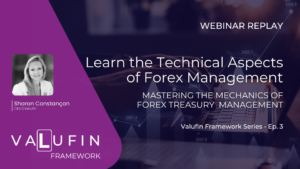
In this webinar replay we introduce the F – Find stage of the VALUFIN Framework, focusing on how businesses actively manage their forex portfolio. The session explores how decisions are made across instruments, time horizons, and market conditions, and how these interact within the broader business environment.
This session is particularly relevant for finance directors, treasury managers, and business leaders responsible for managing international transactions and financial exposure.
Valufin empowers your organisation with tailored insights, expert execution, and technology-driven solutions. Let’s transform uncertainty into opportunity.
Is Your FX Risk Being Managed as a Portfolio?
Move beyond individual transactions and create greater visibility, consistency, and control across your foreign exchange decisions.